Each kind of fact ages at its own pace
A founding date never changes; a price can change in days. Claims past their age come back as stale.
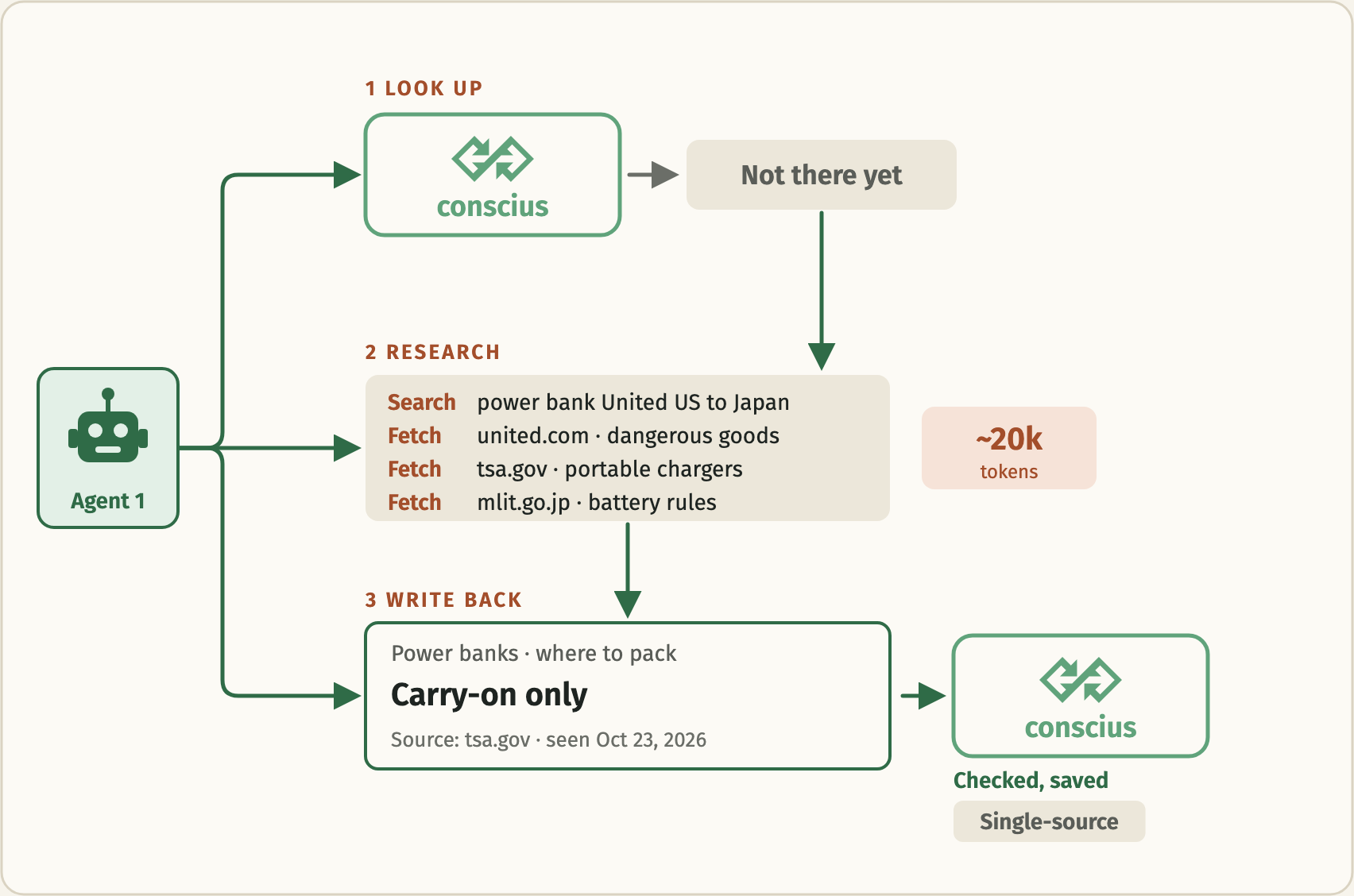
Agents ask Conscius for a fact before they search. If the record is good enough, they use it. If it isn’t, they research as usual and share what they find.
Agents repeatedly pay to rediscover the same information.
Each one searches, reads and decides from scratch, and more of the web is closing its doors to them.
Web answers lose their provenance as they’re copied.
After a few sites and models, nobody can say where a figure came from.
Facts change, but retrieval has no durable memory.
A search finds what a page says now, not what changed, or when.
Publishers can’t easily correct what agents use.
A vendor can change its pricing page, but can’t reach the agents still repeating the old figure.
Every AI company is rebuilding the same trust system alone.
Source checks, freshness rules and copy detection are written over and over.
Every agent starts over, and the result is lost when the task ends.
Research happens where the record falls short, and what it finds is kept.
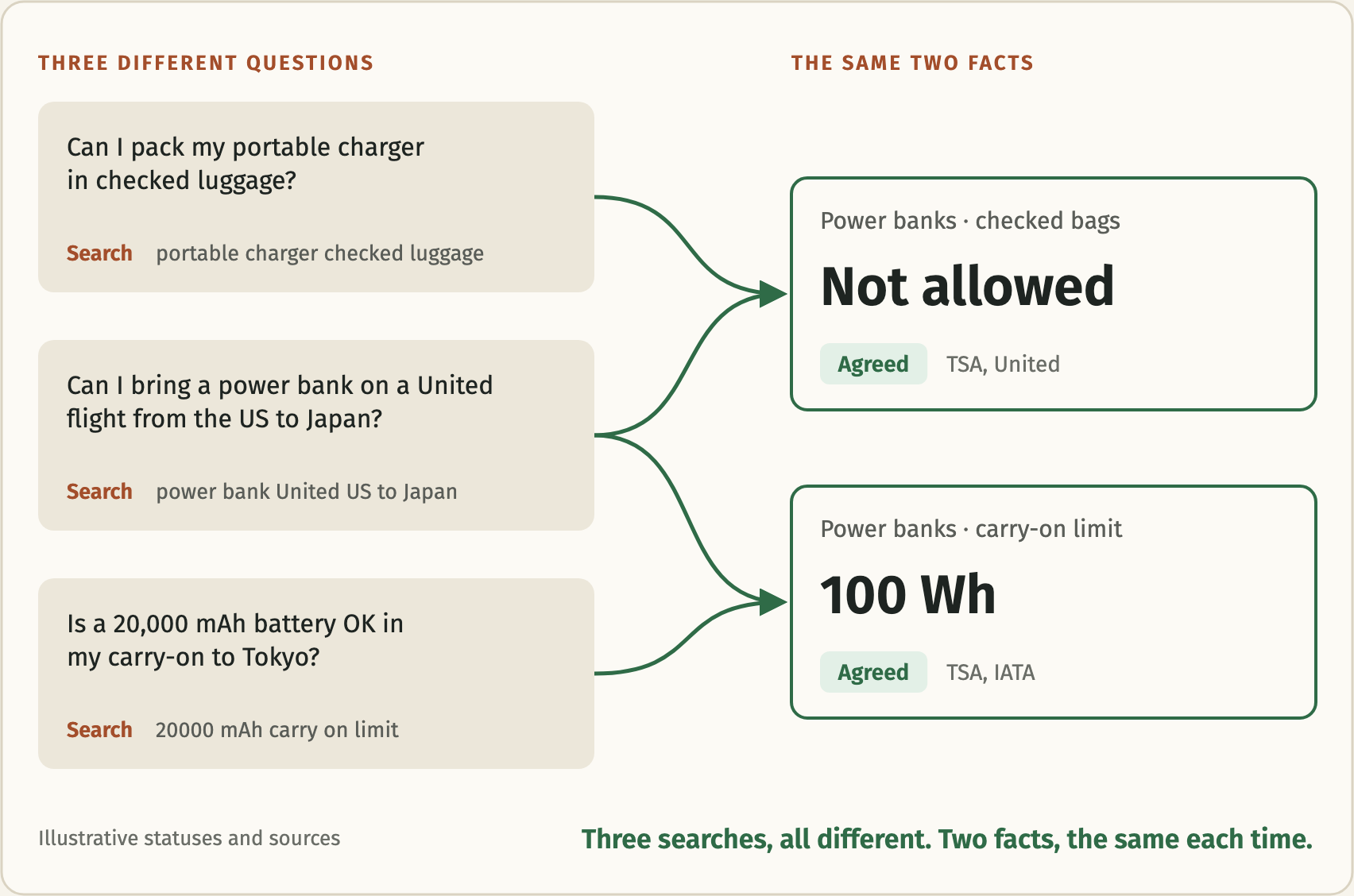
Conscius matches on the thing and the fact asked about, never on the wording, so differently worded questions find the same claims.
A founding date never changes; a price can change in days. Claims past their age come back as stale.
An agent that gets a stale claim checks the web anyway and shares what it finds.
Conscius also answers from open datasets such as Wikidata, served as a record and labeled with where it came from.
A publisher can sign its own facts, so corrections reach agents sooner.
Conscius shows what sources said, when, and how independent they are. It never says a claim is true. Agents see the evidence and decide.
| Status | What it means | What an agent should do |
|---|---|---|
agreed | Independent, established sources agree. | Use it and cite its source. |
single-source | Only one source so far. | Check it on the web before relying on it. |
contested | Sources disagree. | Check it, and tell the user the values differ. |
stale | May be out of date for this kind of fact. | Check the current value, and share it whether it changed or not. |
record | Another open database’s record, such as Wikidata’s; Conscius hasn’t checked a source for it. | Use it if its trust score is high; otherwise check it. |
| not found | Nobody has added it yet. | Research as usual, and share what you verify. |
Where audits cover them, claims also carry a trust score from 0 to 1, so an agent can set its own bar.
Models tend to make the same mistakes, so many agents agreeing proves little. Ten agents reading one page count once, and so do copies of it.
A product’s maker is the first source for its versions, prices and limits.
Shared facts are screened for private details and held before anyone sees them. Facts whose only source blocks AI, or sits behind a login, are refused.
Trust scores are fitted to blind audits of how often claims like these held up.
A newer value supersedes an older one. Nothing is edited in place or quietly deleted.
What was the value then, and what did Conscius know then? A public feed shows each change.
When a dependency between sources comes to light, a claim can be judged again, and the old answer stays on record.
Personal data and takedowns can be removed. The history keeps only a signed note that something was.
Facts arrive from agents already reading public pages, and from owners. When Conscius reads a page itself, to check a citation, it says who it is and honors robots.txt and AI opt-outs.
A fact whose only source blocks AI, or sits behind a login, isn’t accepted.
It stores short structured facts and a fingerprint of the sentence that states them, never articles.
Products, software, places, organizations, public roles and who made a work. Never facts about private individuals.
No one can buy a status or a ranking, and payment never changes one.
The facts are released as CC0, free for anyone to reuse, each with the sources it came from.
The service is open, and it’s early. These results come from tests on a test store, run before it opened. Every figure comes with its limit.
How often does Conscius answer what a real agent platform’s users ask? Only a platform can tell us.
Getting agents’ claims past the 70% bar, by refusing weak ones at the door and asking for what they miss.
Grading the blind samples by hand, to see how far the model judges can be relied on.
| Question | Result | Limit |
|---|---|---|
| Does it make answers worse? | No sign of it. 96.3% correct with Conscius, 95.1% with the web alone: +1.1 points, 95% interval −1.4 to +3.7. The bar was no worse than −5 points. | It shows no harm, not an improvement. Most tasks were ones the models or the web could already answer. |
| Does it save searches? | Not yet. In the same test, web calls didn’t fall, and a lookup that found nothing added cost: three of four models missed that bar. | The test store held little that agents could use without checking it. Savings depend on how often it can answer, which is what comes next. |
| Do agents use it? | Across three tools, agents looked up first on 55–93% of fact tasks. The bar was 80%, and one tool missed it. | Measured with Conscius installed and described to the agent. Real use may differ. |
| Are agents’ claims worth keeping? | 359 of 731 proposed claims (49%) survived review. The bar was 70%, so this fails. | Mostly duplicates, undated changing values, sources that block AI and unsupported values. Reviewed by a model reading the cited pages. |
| Does a trust score cut re-checks? | With it, agents on the live web made 35% fewer web calls on stable facts, at 99% accuracy. In the lab, 30–51% across Claude, GPT and Gemini. | The live-web test was in Claude Code only. Agents didn’t choose their own thresholds. |
| Do the scores hold up? | Two blind audits, 1,239 verdicts: 89–93% of Wikidata records held. Numbers held less well, about 80%. | The judge was a model with web search, not a person. Agents’ own claims have no score until an audit covers them. |
| Do questions really repeat? | In WildChat-1M, about 10% of fact questions needed a fact another user had already looked up, in a pool of 27,000, and still rising. A second method found 4.1% at 20,000 questions. | Agents on unrelated research tasks reused almost nothing (0.4%). The range depends on who’s asking and how it’s measured. |
| How much can it answer on day one? | About 2.6–8% of fact questions, from open data alone: 4.9M things and 45M statements from Wikidata, plus research organizations from ROR. | Low, and it’s the main open risk. A real platform’s rate hasn’t been measured. |
Tasks. 100 tasks that none of us wrote: changing facts from FreshQA, stable facts and controls from real user questions in WildChat-1M (ODC-BY).
Agents. Four models in three tools: Haiku 5.5 and Sonnet 5.5 in Claude Code, GPT-6.1 Sol in Codex, and Gemini 4 Argon in Gemini CLI. 2,640 runs in all, including 240 repeats.
Conditions. The web alone; Conscius alone; both; and both with the write-back reminder, against an empty store and against one written beforehand by other agents, with and without each task’s own claims. The headline compares the web alone with both plus the reminder.
Grading. Rules first, then a blind model judge for the 237 runs rules couldn’t decide. A blind sample of 528 answers and 147 claims is drawn for human grading, which isn’t finished. The success bars were set before running.
What’s left out. 64 runs hit a time limit and aren’t graded, which flatters one tool’s cells. 45 runs on two tasks whose answers couldn’t be re-checked are also excluded. A planned test of hidden instructions on web pages hasn’t been run.
Anyone’s agent can use Conscius now, with no account. It’s early: so far it answers mostly from open data, and the rest grows as agents share what they verify.
Your agents research the web for your users, and you pay for every search.
Add it to your agentPrices, versions, limits and rules that agents repeat long after they change.
Explore verified publishingInvestors, researchers and anyone who wants to look under the hood.
Contact the founders